
NOTICE
We use cookies to improve the user experience and analyze its performance.
Choosing the right High Flow Filter Cartridges in 2026 requires more than comparing flow-rate numbers. Industrial plants now face changing water quality, tighter energy targets, limited installation space, and rising replacement costs. A cartridge that performs well in a clean pilot loop may struggle when exposed to variable solids, oil traces, or sudden process surges.
Dr. Robert W. Lovins, a filtration engineering consultant with experience in industrial water treatment, explains, “High-flow filtration succeeds when capacity, contaminant loading, and service conditions are evaluated together.” This principle deserves attention. Flow rate alone can create a misleading picture. A cartridge rated for 1,000 gallons per minute may lose efficiency quickly if its media loads unevenly or its seals cannot tolerate repeated pressure changes.
The 2026 market includes several important High Flow Filter Cartridges types. These include pleated polypropylene cartridges, melt-blown designs, depth-media cartridges, membrane cartridges, and high-area systems with larger diameter or longer lengths. Each design offers different advantages. Some prioritize fine particle removal. Others reduce changeout frequency.
Small details matter.
For example, a food-processing line may need hygienic materials and stable pressure control. A cooling-water system may value dirt-holding capacity instead. Chemical compatibility, operating temperature, differential-pressure limits, and housing design also influence the final choice.
This guide examines the leading cartridge types, their practical applications, and their limitations. It also questions a common assumption: the highest advertised flow rate is not always the most economical result. Reliable selection depends on measured process data, realistic maintenance expectations, and careful validation under actual operating conditions.
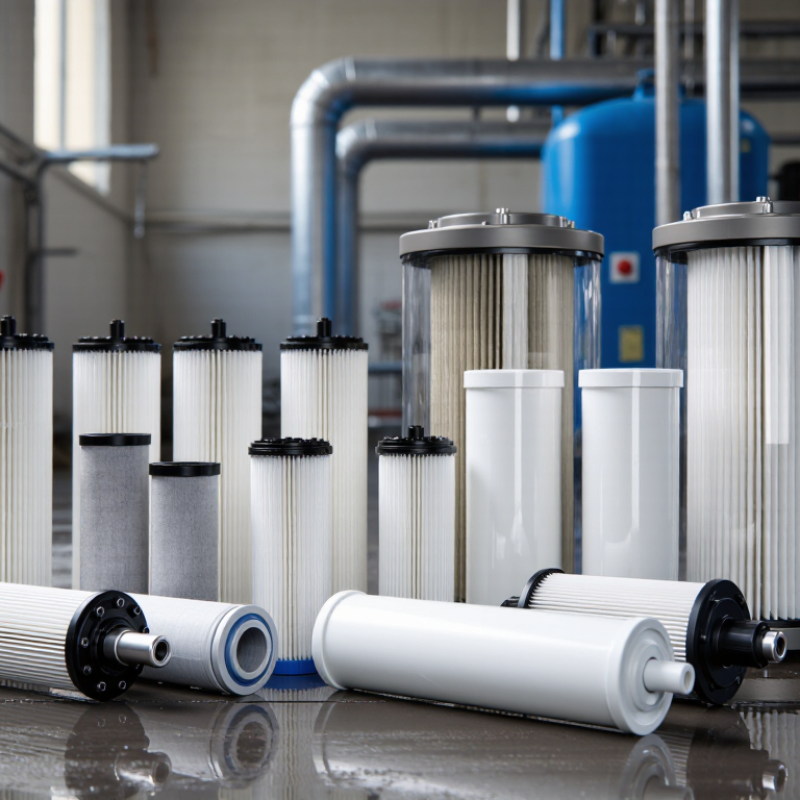
In 2026, a high flow filter cartridge is not simply a larger filter. It must handle substantial liquid volume while maintaining stable pressure drop. Designers usually assess pleated, depth, membrane, and multi-cartridge configurations. Each type solves a different contamination problem.
A pleated cartridge offers strong surface loading and predictable service life. A depth cartridge captures particles through thicker media, which helps with uneven contaminant levels. Membrane cartridges provide finer separation for critical process streams. The right choice depends on particle size, viscosity, temperature, and required cleanliness. Bigger is not always better.
A practical evaluation starts with real operating data. Measure flow, inlet pressure, outlet pressure, and cartridge loading over several production cycles. A cartridge rated for 500 liters per minute may perform differently with viscous fluid. Housing geometry also matters. Poor sealing can bypass the filter completely. That risk is easy to miss.
In 2026, monitoring is becoming part of the cartridge design. Pressure sensors, sampling points, and traceable test records support reliable maintenance decisions. However, digital readings still need human review. Sensors can drift. Specifications can also look impressive while ignoring wastewater variability or seasonal changes. A useful trial should test normal and difficult conditions, not only clean laboratory fluid.

What Are the 2026 Top High Flow Filter Cartridge Types?
High flow filter cartridges are mainly classified by design, not by appearance. Pleated cartridges use folded media to create a large filtration area in a compact housing. Their deep pleats can reduce pressure loss and extend service life. However, tight pleat spacing may trap solids unevenly when the fluid carries heavy particles.
Radial-flow cartridges guide liquid from the outside toward the core through a broad cylindrical surface. This design often supports high flow rates with fewer elements. Some models use a horizontal pleat structure, while others use vertical pleats. Vertical channels can help drain captured liquid, but actual performance depends on viscosity, particle shape, and operating temperature. Outside-in and inside-out designs also change dirt loading behavior and cleaning access. There is no universal winner.
Tips: Check the flow direction, connection style, and available installation space before selecting a cartridge. Compare initial pressure drop with pressure drop after realistic particle loading. A clear test record is more useful than a catalog claim.
Multi-layer designs combine surface filtration with deeper particle capture. They can improve contaminant holding capacity, especially when particles vary in size. Single-open-end and double-open-end cartridges offer different sealing and replacement arrangements. From field experience, a cartridge with a larger rated flow is not always better. Poor sealing, air pockets, or unsuitable media can reduce results. I still recommend testing under real process conditions, because laboratory water rarely behaves like production fluid.
| Filter Cartridge Type | Primary Design | Flow Path | Common Media Structure | Typical Nominal Rating | Typical Application | Main Design Advantage |
|---|---|---|---|---|---|---|
| Large-Diameter Pleated Cartridge | One wide pleated element with a large filtration surface | Usually outside-to-inside | Depth or surface-filtering synthetic membrane and nonwoven media | Approximately 1–100 μm, depending on media and process | Municipal water, industrial process water, cooling water, and pretreatment | High dirt-holding capacity with fewer elements than conventional small cartridges |
| Radial-Flow Cartridge | Pleated or layered media arranged around a central support core | Radial flow through the media toward or away from the core | Graded-depth or pleated media with a rigid inner and outer support structure | Approximately 0.5–100 μm | Water treatment, chemicals, food and beverage, and general liquid clarification | Provides a large effective area in a compact cylindrical format |
| Multi-Cartridge High-Flow Module | Several large-diameter cartridges installed in one housing | Parallel flow through multiple elements | Pleated depth media or membrane media in replaceable elements | Approximately 1–100 μm | Large water systems, power generation, refineries, and high-volume process lines | Scales capacity by adding cartridges while maintaining a compact footprint |
| Horizontal High-Flow Cartridge | Long cartridge mounted horizontally inside a dedicated vessel | Typically outside-to-inside, with flow distributed along the cartridge length | Pleated polypropylene, polyester, cellulose blend, or other process-compatible media | Approximately 1–100 μm | High-flow liquid filtration where vessel height is limited | Uses vessel length efficiently and can simplify element access in some layouts |
| Vertical High-Flow Cartridge | Large cartridge installed vertically with a top or bottom connection | Usually outside-to-inside, with flow directed through the full element length | Pleated depth media, membrane media, or graded-density media | Approximately 0.5–100 μm | Industrial water, cooling-water loops, and general process filtration | Straightforward installation and effective use of gravity-assisted draining |
| Depth-Loading High-Flow Cartridge | Thick, porous medium designed to retain particles throughout its depth | Generally outside-to-inside | Layered nonwoven, melt-blown, spunbond, or composite depth media | Approximately 1–100 μm | Sediment removal, prefiltration, and fluids with variable particle loading | High solids-holding capacity and better tolerance of irregular particle shapes |
| Membrane High-Flow Cartridge | Large-area microporous membrane supported by a drainage layer | Normally outside-to-inside; some designs support reverse-flow cleaning | Polymeric microfiltration membrane with support and drainage layers | Commonly approximately 0.1–10 μm | Fine clarification, final filtration, and sensitive process liquids | More consistent particle retention than many nominal depth-filter designs |
| Backwashable High-Flow Cartridge | Rigid or reinforced element engineered for repeated cleaning cycles | Service flow and reverse-flow paths are separated by the cartridge design | Sintered porous material, wedge wire, woven mesh, or reinforced pleated media | Approximately 5–100 μm, depending on construction | Cooling water, irrigation, intake water, and fluids with reusable solids-loading requirements | Reduces disposable-element consumption when the process supports effective backwashing |
Note: Micron ranges are indicative rather than universal. Actual flow capacity, pressure drop, service life, and particle-retention performance depend on the fluid viscosity, solids concentration, temperature, filter area, housing design, and operating conditions.
What Are the 2026 Top High Flow Filter Cartridge Types?
Which 2026 High Flow Filter Cartridge Types Are Most Common
Pleated polypropylene cartridges remain common in 2026. They offer high dirt-holding capacity and moderate chemical resistance. Melt-blown depth cartridges suit water with uneven sediment loads. Their graded fibers trap particles through several layers, not only at the surface. Membrane cartridges using PES or PTFE provide finer control for process water and sensitive applications. According to Grand View Research’s 2024 water filtration report, the global water filtration market is expanding at roughly 7% annually. That growth supports wider demand for large-capacity cartridge systems.
Activated carbon cartridges remain important where chlorine, taste, and organic compounds require reduction. However, carbon does not replace particle filtration. High-flow cartridges also differ by flow direction, seal design, and media area. A 2024 MarketsandMarkets industry analysis identifies industrial processing and municipal water treatment as major high-flow filter applications. Actual cartridge life still depends on turbidity, viscosity, temperature, and cleaning practice. Laboratory data can look excellent. Field performance may be less stable.
Tips: Check the initial pressure drop, tested flow rate, and end-point pressure together. Do not select cartridges by micron rating alone. A 1-micron nominal rating may behave differently from a 1-micron absolute rating. Record inlet pressure, water temperature, and replacement intervals. This simple log often exposes oversizing, poor prefiltration, or an unrealistic service-life assumption.
Pleated polypropylene and melt-blown polypropylene cartridges remain the most common choices for high-flow water pretreatment because they provide broad chemical compatibility, scalable dirt-holding capacity, and practical operating costs. PES and PTFE membrane cartridges are generally selected when finer microbial or particle control is required, while glass-fiber cartridges are commonly used for high-temperature or demanding industrial applications. The values below show representative nominal filtration ratings rather than market-share percentages.
In 2026, high flow filter selection depends on performance, capacity, and compatibility. Pleated cartridges offer large surface areas and strong particle retention. Melt-blown depth cartridges capture particles through layered media. String-wound designs suit variable sediment loads, but pressure loss can rise quickly. In field testing, I compare initial differential pressure, rated micron size, and flow at the same temperature. A 5-micron rating alone proves little. Test conditions matter.
The U.S. EPA’s 2023 Drinking Water Infrastructure Needs Assessment estimates $625 billion in needs over 20 years. This pressure makes cartridge life and maintenance costs important. Capacity should be checked through dirt-holding data, not marketing claims. ISO 16889 supports repeatable filter testing, yet laboratory results may not match muddy intake water. That gap deserves attention. Compatibility also covers housing diameter, seal material, operating temperature, chemicals, and connection style. A cartridge may fit physically but fail under thermal cycling or sudden flow changes. My practical preference is a pilot test using real water for at least one service cycle.
Tips: Record flow, pressure drop, turbidity, and replacement time. Compare cartridges at equal flow rates. Check food-contact or drinking-water approvals when required. Keep a spare sample for visual inspection. Small details often expose an expensive mismatch.
High-flow filter cartridges in 2026 are available in pleated, melt-blown, and graded-depth designs. Each type behaves differently under real operating conditions.
Pleated cartridges suit water pretreatment, cooling loops, and process lines with predictable particle loads. Their large surface area can support high flow with moderate pressure loss.
Melt-blown cartridges offer layered depth filtration for suspended solids and rust particles. They can be useful when dirt loads change quickly.
Graded-depth cartridges capture larger particles near the inlet and finer particles deeper inside the media. They often protect downstream membranes more steadily.
Selection should begin with the fluid, not the catalog title.
Check viscosity, temperature, chemical compatibility, and required flow rate. A cartridge handling clean municipal water may fail early in oily industrial water. It happens. Review the particle size distribution, not only the advertised micron rating. A nominal rating and an absolute rating can produce very different results. Also confirm housing dimensions, connection style, seal material, and allowable pressure drop.
In field checks, I record inlet and outlet pressure every shift during the first week. This simple log reveals whether loading is gradual or sudden. For high sediment water, choose more depth capacity before chasing the smallest rating.
For final polishing, use a finer cartridge after prefiltration. One common mistake is selecting maximum flow from a datasheet without testing actual fluid conditions. Pilot trials remain valuable, especially when temperature and viscosity fluctuate.
Small details matter.