NOTICE
We use cookies to improve the user experience and analyze its performance.
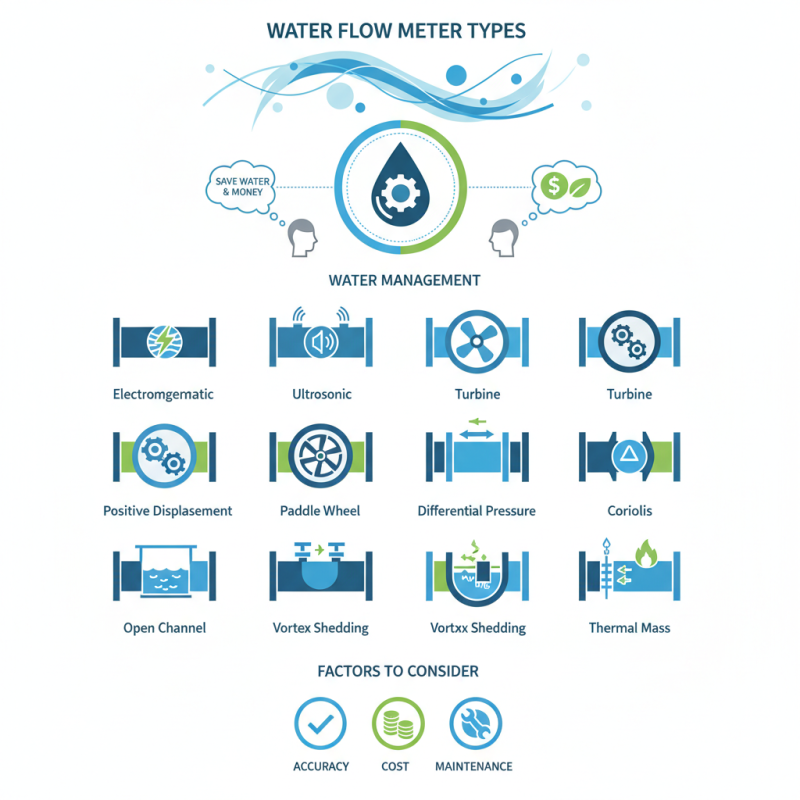
In today's world, monitoring water usage is crucial. Experts like Dr. Emily Hart, a leading authority in water management, assert, "Choosing the right water flow meter can save both water and money." There are various types of water flow meters available, each with its unique features and applications.
Understanding these options is essential for industries and households alike. Different meters measure flow rates, from electromagnetic to mechanical types. Each type has its advantages and limitations. For instance, electromagnetic flow meters work well in clean liquids but may struggle with dirty or viscous fluids.
This complexity can be confusing for many consumers. It’s important to select a meter that fits specific needs and conditions. Some might opt for a simpler solution while others may need advanced technologies. The decision must consider accuracy, cost, and maintenance. Reflecting on these factors can lead to a more informed choice in the water flow meter market.
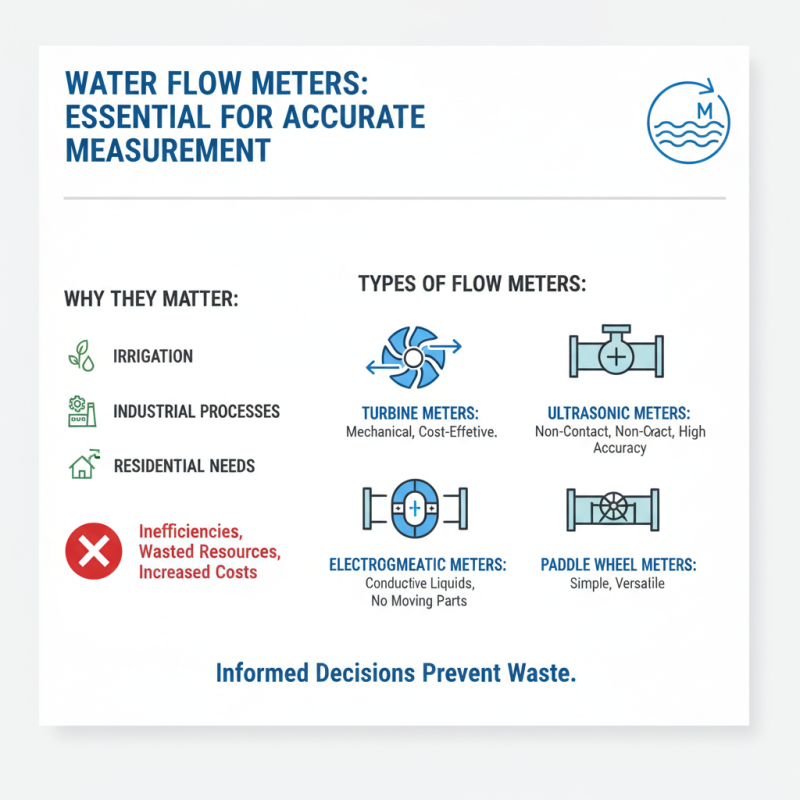
Water flow meters are vital for various applications. They measure the volume or flow rate of water in different systems. Proper measurement is crucial for irrigation, industrial processes, and residential needs. Without accurate data, inefficiencies can arise. This leads to wasted resources and increased costs. Understanding the types of flow meters helps users make informed decisions.
When choosing a flow meter, consider installation location and purpose. Some meters suit industrial settings, while others are meant for residential use. Always think about the environment they will operate in. Choose devices that can handle extreme temperatures or pressures. This selection process can be tricky. Mistakes might prove costly in the long run.
Tip: Regular maintenance is essential for accuracy. Fluctuations in readings can signal issues. It's wise to check for blockages or wear regularly. Also, ensure calibration is performed periodically. Every meter has specific requirements. Staying informed prevents unexpected failures. Engage with professionals if uncertainties arise. They can guide you through the selection and installation processes.
Mechanical flow meters play a crucial role in various industries. These devices measure the flow of liquids and gases. Their accuracy is vital for effective operations. Different types of mechanical flow meters cater to different applications.
Positive displacement flow meters
are popular for their accuracy. They work by trapping a fixed volume of fluid. Then, they release it, measuring the flow rate. Turbine flow meters rely on a rotating turbine. As fluid flows, it spins the turbine. The speed of rotation correlates to the flow rate.
In some cases, mechanical flow meters face challenges. They may be susceptible to wear and tear. This can affect their accuracy over time. Users must regularly calibrate and maintain these devices. Some may find the initial installation complex. Understanding these aspects can lead to better decision-making in selecting the appropriate flow meter for specific needs.
Electromagnetic flow meters are innovative devices widely used in various industries. They measure the flow of conductive liquids using electromagnetic principles. This technology is based on Faraday’s law of electromagnetic induction. When a conductive fluid flows through a magnetic field, it generates a voltage proportional to its flow rate.
One significant benefit of using electromagnetic flow meters is their accuracy. They can provide precise measurements over a wide range of flow rates. This accuracy is crucial for applications like water treatment and chemical processing. Additionally, electromagnetic meters have no moving parts, reducing maintenance needs. However, they require specific conditions, like electrical conductivity in the fluid, which not all liquids possess.
Electromagnetic flow meters also have some limitations. They are not suitable for non-conductive fluids like oils or gases. Depending on installation, they might experience measurement lag. Ensuring proper installation can be challenging. Users should assess their specific application needs carefully. Understanding these factors helps in making informed decisions about flow measurement.
Ultrasonic flow meters have gained traction in several industries due to their unique features. These devices use sound waves to measure fluid flow without physical contact. They are non-intrusive, which means minimal disruption to the flow system. According to a recent industry report, the adoption of ultrasonic flow meters has increased by 20% over the last three years. This trend reflects their growing reliability and accuracy.
These meters excel in measuring clean and dirty fluids. They can handle various fluid types, from water to corrosive substances. They are suitable for applications in water treatment plants and petroleum industries. Recent data indicates that these meters can reduce maintenance costs by 30%. However, they rely heavily on accurate calibration. Miscalibration can lead to significant errors in flow measurements.
The benefits are clear, yet some challenges remain. Ultrasonic flow meters can struggle with turbulent flow conditions. Their reliability decreases when measuring fluids with bubbles or solids. Industries need to evaluate their specific needs before opting for this technology. It’s essential to weigh the pros and cons and consider operational conditions.
| Flow Meter Type | Measurement Principle | Accuracy | Typical Applications | Key Features |
|---|---|---|---|---|
| Ultrasonic Flow Meter | Time-of-Flight | ±0.5% of reading | Water, Wastewater | Non-invasive, High repeatability |
| Electromagnetic Flow Meter | Faraday's Law | ±0.2% of reading | Conductive liquids | No moving parts, Suitable for slurries |
| Turbine Flow Meter | Mechanical | ±1% of reading | Beverages, Oil | High accuracy, Compact design |
| Positive Displacement Flow Meter | Mechanical | ±0.5% of reading | Low flow rates, Oils | High viscosity fluids, Directional measurement |
| Vortex Flow Meter | Vortex Shedding | ±1.0% of reading | Steam, Gas | Wide range of applications, Robust design |
| Mass Flow Meter | Coriolis Effect | ±0.1% of reading | Chemicals, Gases | Direct mass flow measurement, High accuracy |
| Differential Pressure Flow Meter | Pressure Differential | ±2% of reading | Water, Air | Versatile, Cost-effective |
| Variable Area Flow Meter | Float Measurement | ±2% of reading | Small flows, Gases | Simple design, Visual indication |
| Oscillating Piston Flow Meter | Piston Oscillation | ±0.5% of reading | Low viscosity fluids | High accuracy, Suitable for small flows |
| Smart Flow Meter | Digital Technologies | Varies by type | Industry 4.0 Applications | Data logging, Remote monitoring |
Choosing the right flow meter is crucial for efficiency and accuracy in water management. Various types exist, and understanding their unique features is essential. According to a report from the American Water Works Association, proper flow measurement can enhance resource management by up to 30%.
When selecting a flow meter, consider your application. Ultrasonic meters are non-intrusive and work well in clean water scenarios. Pressure-based meters are more suited for wastewater applications. The correct choice can significantly impact your operations and maintenance costs.
Tips: Always assess the fluid type and temperature before purchasing. Ensure your meter can handle expected peaks in flow. Also, regular calibration and maintenance extend the life of your equipment. If your flow meter is not performing optimally, it becomes a financial burden. Reviewing these factors helps prevent costly mistakes.
This chart illustrates the popularity of various types of water flow meters based on industry usage. The data represents the percentage of preference among users for each flow meter type.