NOTICE
We use cookies to improve the user experience and analyze its performance.
LoRaWAN sensors are small, battery-powered devices that connect physical conditions with cloud applications. They can measure temperature, humidity, water levels, vibration, occupancy, or utility consumption. A sensor may sit inside a warehouse, beneath a parking space, or beside an irrigation pipe. It sends compact data through LoRaWAN, a low-power wide-area networking protocol.
The growth of connected infrastructure makes this technology increasingly relevant. GSMA Intelligence’s The Mobile Economy 2024 forecasts 29.4 billion Internet of Things connections by 2030. LoRa Alliance reports that LoRaWAN deployments now span more than 170 countries. These figures show strong momentum, but they do not guarantee that every project will succeed.
So, how does the system work?
A lorawan sensors network usually includes end devices, gateways, a network server, and an application platform. The sensor collects a reading and transmits a radio packet. Nearby gateways receive that packet and forward it through an IP connection. The network server removes duplicates, checks security credentials, and manages device communication. The application then turns raw values into alerts, dashboards, or automated actions.
LoRaWAN uses long-range radio communication with very low energy consumption. Many devices can operate for years, depending on reporting frequency, signal conditions, battery type, and environmental exposure. Its adaptive data rate can improve efficiency when coverage is stable.
However, LoRaWAN is not a universal replacement for cellular, Wi-Fi, or wired systems. Payload sizes are limited. Downlink communication is constrained. Buildings, metal structures, and poor gateway placement can reduce reliability. Security also requires disciplined key management and proper device commissioning. These practical details matter more than impressive range claims. This article examines the architecture, operating process, benefits, limitations, and real-world selection criteria behind LoRaWAN sensors.
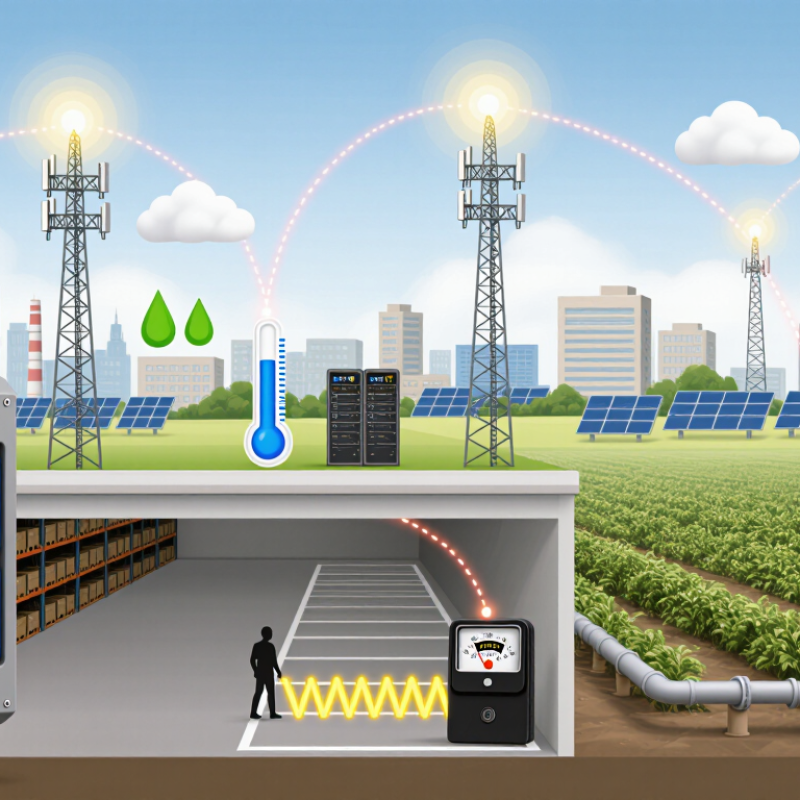
LoRaWAN sensors are small wireless devices that measure physical conditions and send the readings over a low-power network. They can track temperature, humidity, air quality, water levels, motion, or equipment status. A sensor usually contains a measuring element, a battery, a processor, and a radio module.
The device collects data at set intervals, then transmits a compact message through LoRaWAN. Nearby gateways receive the signal and forward it to a network server. Applications can then display the information as charts, alerts, or maintenance records. The sensor does not normally need a mobile connection or continuous power. That matters.
In a warehouse, a temperature sensor might sit beside stored goods and report changes every ten minutes. In a building, a door sensor can reveal unusual activity without constant wiring. Long-range communication is useful where cables are expensive or difficult to install. However, LoRaWAN sensors are not perfect. Thick walls, metal structures, poor placement, and regional radio rules can affect performance. Battery life also depends on transmission frequency, signal conditions, and sensor quality. Real installations need testing, calibration, and periodic inspection. A reading may look precise while the sensor itself has drifted. That detail is easy to overlook. Reliable use requires comparing measurements with trusted references and recording maintenance actions.

A LoRaWAN sensor is built from several coordinated parts, each serving a practical purpose. The sensing element measures a physical condition, such as temperature, humidity, motion, pressure, or air quality. Its accuracy depends on calibration, placement, and environmental exposure. A sensor beside a warm motor may report useful data, but not the room’s true temperature.
A microcontroller processes the measurement and controls the device’s operating schedule. It can filter sudden changes, store readings, and prepare small data packets. The LoRa radio then converts those packets into long-range wireless signals. An antenna sends and receives the signal. Its design and position matter greatly. A metal cabinet can weaken transmission, even when the electronics work correctly.
Power usually comes from a battery, energy-harvesting circuit, or external supply. Battery-powered devices often sleep between readings to reduce consumption. An enclosure protects the circuit from dust, moisture, and accidental impact. Seals, vents, and mounting points must match the installation site. Firmware connects these components and manages timing, security, retries, and fault handling. A gateway is not normally part of the sensor itself; it receives the radio message and forwards it to an application server. In field testing, battery-life estimates are never perfect. Cold weather, weak signals, and frequent transmissions can change results. Designers should measure real performance instead of trusting laboratory figures alone.
| Component or Dimension | What It Is | Primary Function | Typical Technical Details | How It Participates in Data Transmission |
|---|---|---|---|---|
| Physical Sensor Element | A device that detects a measurable physical condition. | Converts temperature, humidity, pressure, motion, light, soil moisture, or another condition into an electrical signal. |
Analog
Digital
Contact
Measurement accuracy, range, response time, and environmental stability depend on the sensing technology. |
The measured signal is sent to the microcontroller for processing before it is included in a wireless payload. |
| Signal-Conditioning Circuit | Electronic circuitry placed between the sensing element and the processor. | Filters noise, scales voltage, provides excitation, or converts a weak sensor signal into a usable electrical signal. | May include amplifiers, voltage references, filters, pull-up resistors, or an analog-to-digital converter. | Improves measurement consistency and prepares the signal for sampling by the microcontroller. |
| Microcontroller Unit | A low-power embedded processor. | Reads sensor values, applies calibration, manages timing, controls sleep modes, and prepares the application payload. | Usually includes digital interfaces such as I²C, SPI, UART, GPIO, and sometimes an integrated analog-to-digital converter. | Creates the data message, controls the LoRaWAN radio, and keeps the device in low-power sleep between measurements. |
| LoRaWAN Radio Transceiver | A low-power radio circuit that uses chirp spread-spectrum modulation for the LoRa physical layer. | Transmits and receives wireless packets over long distances while using relatively little energy. | Operates in region-dependent sub-gigahertz unlicensed spectrum. Communication settings include frequency, bandwidth, spreading factor, coding rate, and transmit power. | Encodes the payload into a LoRaWAN uplink and receives downlink messages such as configuration commands or acknowledgements. |
| Antenna and Matching Network | The radiating element and the supporting circuit that connects it to the radio. | Transfers radio-frequency energy efficiently between the transceiver and the surrounding environment. | Antenna performance depends on frequency, physical placement, ground conditions, enclosure material, and impedance matching. | Determines much of the practical radio range, link quality, and energy required for reliable communication. |
| Power Source | The energy supply for the sensor electronics and radio. | Provides regulated electrical power during sensing, processing, transmission, and sleep periods. | Common options include primary batteries, rechargeable batteries, external DC power, and energy-harvesting systems. | Battery life is influenced by measurement frequency, transmit power, radio settings, sensor current, temperature, and downlink activity. |
| Power-Management Circuit | Circuitry that regulates, distributes, and monitors electrical power. | Converts input voltage, prevents excessive current draw, disconnects unused sections, and may monitor battery condition. | Can include voltage regulators, load switches, charging circuits, protection devices, and battery measurement inputs. | Allows the device to spend most of its time in a low-power state and wake only for scheduled tasks or configured events. |
| Firmware | Embedded software stored in the sensor device. | Controls measurement schedules, data processing, radio behavior, error handling, security functions, and power-saving logic. | May support periodic reporting, threshold-based alerts, confirmed or unconfirmed uplinks, adaptive data rate, and remote configuration. | Packages sensor readings into application data and follows the LoRaWAN protocol procedures for joining and communication. |
| LoRaWAN Protocol Functions | The network communication logic implemented by the device firmware. | Manages device identity, session parameters, frame counters, message types, and network access procedures. | Devices can use Over-the-Air Activation or Activation by Personalization. LoRaWAN uses separate network and application security contexts. | Enables the sensor to join a network, send uplinks, receive permitted downlinks, and protect messages against tampering and replay. |
| Security Credentials | Keys and identifiers used to authenticate and encrypt communication. | Protects the authenticity and confidentiality of sensor data. | LoRaWAN uses AES-based cryptographic protection. Credentials must be securely provisioned and stored in the device. | Network-level security validates the device and network traffic, while application-level security protects application payloads. |
| Real-Time Clock and Timing Circuit | A clock source used for scheduling and timekeeping. | Triggers periodic measurements, coordinates sleep and wake cycles, and supports timestamping. | Timing accuracy, oscillator stability, and clock drift affect reporting schedules and synchronization behavior. | Helps the sensor wake at planned intervals and can support scheduled downlink reception windows. |
| Enclosure and Environmental Protection | The physical housing, seals, connectors, and mounting structure. | Protects electronics from dust, moisture, impact, chemicals, vibration, and temperature extremes. | The required protection level depends on the installation environment. Sensor openings must permit measurement without compromising protection. | Does not transmit data directly, but can affect antenna efficiency, sensor response, thermal behavior, and long-term reliability. |
| Uplink Data Path | The route followed by a measurement sent from the sensor. | Moves application data from the field device to software that can store, analyze, or display it. | Sensor → LoRaWAN gateway → network server → application server or integration endpoint. | The sensor transmits a wireless uplink; gateways forward the radio packet, while network and application systems process it. |
| Downlink Data Path | The route used to deliver permitted commands or settings to the sensor. | Supports configuration changes, control instructions, acknowledgements, or firmware-management operations. | Application server → network server → gateway → sensor, subject to device class, regional rules, and available receive windows. | The device listens during defined receive windows or according to its operating class, helping reduce unnecessary power consumption. |
| Operating Mode | The communication behavior selected for the sensor. | Balances responsiveness, downlink availability, and energy consumption. | Class A provides the lowest power use; Class B adds scheduled receive opportunities; Class C keeps the receiver open when external power is available. | Determines when the sensor can receive downlinks and strongly influences battery life and command responsiveness. |
A LoRaWAN sensor turns a physical change into a compact radio message. A temperature probe, for example, measures air every five minutes. A small controller checks the reading, adds time and device information, then removes unnecessary detail. This reduces payload size and preserves battery power. The sensor may also apply a simple threshold rule. It can transmit only when temperature changes noticeably.
The message then travels through LoRa modulation across long distances, often from a basement meter to a nearby gateway. The gateway forwards the packet to a network server through an internet connection. The server checks device identity, removes duplicate packets, and delivers approved data to an application. Encryption protects the message during this process. However, transmission is not perfectly reliable. Buildings, metal cabinets, interference, and weak installation positions can cause missing packets. Battery condition matters too. A sensor that reports too often may fail earlier than expected.
This small exchange supports a rapidly expanding ecosystem. IoT Analytics reported 16.6 billion connected IoT devices worldwide in 2023. GSMA Intelligence forecasts 29.7 billion IoT connections by 2030. These figures include many technologies, not only LoRaWAN, but they show the pressure for efficient sensing. Field experience also reveals a less tidy reality: calibration drifts, clocks lose accuracy, and “real-time” often means delayed by minutes. Good deployments therefore record signal quality, battery voltage, timestamps, and missing data, instead of trusting every reading blindly.
LoRaWAN sensors measure conditions such as temperature, soil moisture, motion, or water levels. A sensor creates a compact data message and sends it through a low-power radio signal. The message may travel several kilometers, depending on buildings, terrain, and antenna placement. Battery life can last for years when the device transmits small packets occasionally.
The network process begins when one or more gateways receive the message. A gateway does not usually interpret the sensor reading. It forwards the radio packet through an IP connection to a network server. The server checks the message integrity, device identity, and frame counter. It also removes duplicate packets when several gateways hear the same transmission. This improves reliability. The server then manages timing, regional radio rules, and data-rate adjustments. Some decisions depend on signal quality, so performance can change after rain, construction, or battery aging.
After validation, the application layer decrypts and interprets the sensor payload. For example, a byte sequence might become “22.4°C” and “48% humidity.” Downlink commands follow a stricter path because the network must schedule them carefully. Sensors often listen only during brief receive windows, which limits immediate control. In field testing, messages can still arrive late or disappear. That is not always a network failure; weak placement, interference, and sleeping devices matter. Engineers should record signal levels, gateway coverage, timestamps, and missed packets before changing the hardware.
LoRaWAN sensors are low-power devices that send small data packets across long distances. They commonly measure temperature, humidity, water levels, motion, air quality, or equipment status. A sensor collects a reading, then transmits it to a nearby gateway through a long-range wireless network. The gateway forwards that data to an application server for storage, alerts, or analysis.
Their main value appears in places where wiring is expensive or battery replacement is difficult. Farms can track soil moisture across wide fields. Buildings can monitor room temperature and detect unusual occupancy. Cities may measure flooding risks, waste-bin levels, or street conditions. In industrial facilities, sensors can report vibration or pressure changes before a machine fails. A battery may last for years, but actual life depends on transmission frequency, signal quality, weather, and sensor design.
LoRaWAN is not suitable for every task. Its bandwidth is limited, so it cannot support continuous video, large files, or fast control signals. Thick concrete, underground locations, and metal structures can weaken communication. Public network coverage may also vary sharply between districts. Security depends on correct key management, device configuration, and regular maintenance. A poorly placed gateway can create silent data gaps. That is easy to miss. Measurements also need calibration, because a wireless reading is not automatically an accurate one. In field projects, testing coverage at different times and seasons is wiser than trusting a map alone.
LoRaWAN sensors measure conditions such as temperature, humidity, water level, motion, and energy use. They send small, battery-powered data packets over a long-range, low-power wireless network to a gateway, which forwards the data to an application server.
The chart shows the maximum application payload defined for common EU868 data rates. Lower data rates provide longer range but carry less data, while higher data rates transmit more quickly and support larger payloads. Actual limits vary by regional frequency plan, network settings, and protocol overhead.